
Playing Tightrope Trivia is a fun way to test your knowledge, make quick choices, and enjoy a quiz-style challenge without needing complicated rules. If you are new to the game, you may wonder how it works, what you should do first, and how to improve your score. This guide explains everything in simple steps, from understanding the basic idea to building smart habits while you play. By the end, you will know how to start confidently, avoid common mistakes, and enjoy every round with better focus.
What Is Tightrope Trivia?
Tightrope Trivia is a question-based game where players answer trivia questions while trying to stay balanced between risk and accuracy. The idea is simple: you need to choose the right answers, stay focused, and avoid rushing into guesses that can cost you points or progress.
The game feels exciting because every question can change your position. Some questions may be easy, while others may require careful thinking. This makes the experience enjoyable for beginners and experienced trivia fans alike.
Playing Tightrope Trivia is not only about knowing facts. It is also about timing, confidence, and smart decision-making. You may know the answer, but you still need to stay calm and choose carefully.
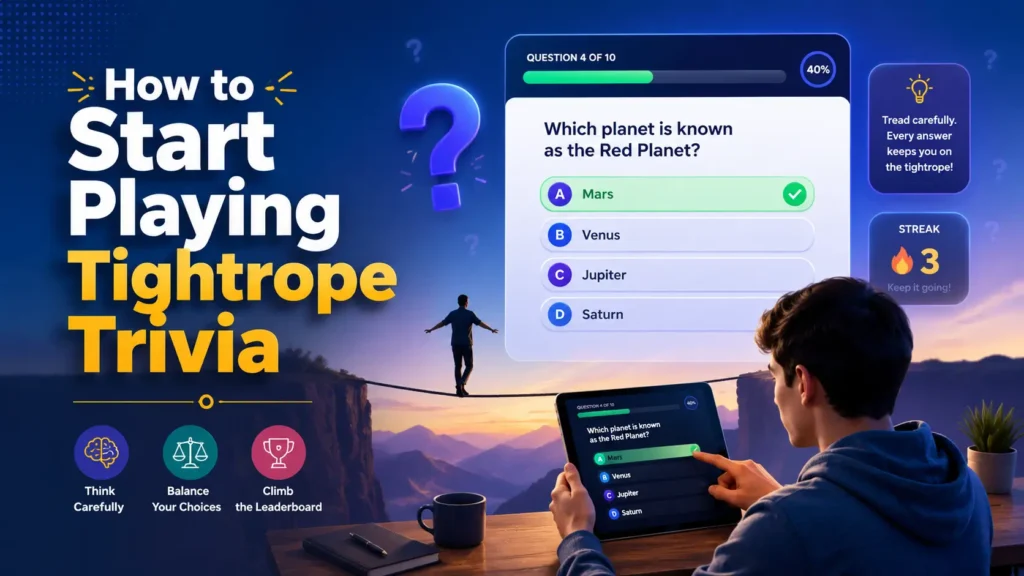
Table of Contents
Why Beginners Enjoy Playing Tightrope Trivia
Many people enjoy Playing Tightrope Trivia because it is easy to understand but still challenging enough to stay interesting. You do not need advanced gaming skills or special equipment. You only need attention, basic knowledge, and a willingness to learn.
Here are a few reasons beginners like it:
- The rules are usually simple to follow.
- Each round feels quick and engaging.
- You can improve with practice.
- The game helps build general knowledge.
- It works well for solo play or friendly competition.
Unlike some games that require long tutorials, Playing Tightrope Trivia lets you start quickly. You can learn most of the game by playing a few rounds and noticing how each question affects your progress.
Basic Goal of the Game
The main goal is to answer trivia questions correctly while keeping your progress steady. The “tightrope” idea usually represents balance. You want to move forward, but careless answers can make the game harder.
In most trivia-style games, correct answers help you gain points, move ahead, or stay safe. Wrong answers may reduce your score, slow your progress, or end the round, depending on the game mode.
When Playing Tightrope Trivia, your job is to combine knowledge with patience. A fast answer is not always the best answer. A careful answer often gives you a better chance of staying in the game longer.
How to Start Playing Tightrope Trivia
Starting is simple if you follow the right order. Before jumping into competitive rounds, take a few minutes to understand the layout, answer options, timer, and scoring system.
Use this beginner-friendly process:
- Open the game and read the first screen carefully.
- Check if there are instructions, categories, or modes.
- Start with an easy or standard mode if available.
- Read each question fully before choosing an answer.
- Watch how your score or progress changes.
- Repeat a few rounds to understand the pattern.
The first few rounds should be treated as practice. Do not worry too much about getting every answer right. The goal is to become familiar with the game flow.
Understanding the Game Screen
Before Playing Tightrope Trivia seriously, learn what each part of the screen means. Most trivia games show the question, answer choices, score, progress bar, timer, or life system.
Here is a simple table to help you understand common screen elements:
| Game Element | What It Means | Why It Matters |
|---|---|---|
| Question Box | Shows the trivia question | Read it carefully before answering |
| Answer Choices | Gives possible answers | Compare each option before selecting |
| Timer | Limits response time | Helps keep the game fast and exciting |
| Score Area | Shows your points | Tracks your performance |
| Progress Bar | Shows your movement or level | Helps you see how far you have gone |
| Lives or Chances | Shows remaining mistakes allowed | Encourages careful choices |
Choosing the Right Game Mode
Some versions of trivia games include different modes, such as easy, normal, hard, timed, or challenge mode. Beginners should start with the simplest option.
Easy Mode
Easy mode is best for new players. Questions are usually simpler, and the pace may feel more relaxed. This mode helps you build confidence.
Timed Mode
Timed mode adds pressure. You need to answer quickly, which makes the game more exciting. Try this only after you understand the basics.
Challenge Mode
Challenge mode is often harder. It may include tougher questions, fewer chances, or faster rounds. This is better after you have gained practice.
If you are Playing Tightrope Trivia for the first time, start with easy or normal mode. Once you feel comfortable, move to faster or more difficult modes.
How to Read Questions Carefully
One of the biggest beginner mistakes is answering before reading the full question. Trivia questions may include small details that change the correct answer.
For example, a question may ask, “Which country is the largest by land area?” This is different from asking “Which country has the largest population?” If you rush, you may choose an answer that sounds right but does not match the question.
When Playing Tightrope Trivia, use this simple reading method:
- Read the full question once.
- Look for key words like “first,” “largest,” “oldest,” or “not.”
- Remove answers that are clearly wrong.
- Compare the remaining choices.
- Select the answer only when you are confident.
This habit can improve your score even if you do not know every topic perfectly.
Smart Answering Strategies
Trivia games reward both knowledge and clear thinking. Even when you are unsure, you can still improve your chances by using smart strategies.
Use Elimination
If you do not know the answer, remove choices that seem impossible. This leaves fewer options and gives you a better chance.
Trust Strong Knowledge
Sometimes your first thought is correct because you have seen the fact before. If you are confident, do not overthink too much.
Watch for Trick Words
Words like “always,” “never,” “except,” and “not” can change the meaning of a question. Slow down when you see them.
Avoid Random Guessing Too Early
Guessing may be necessary sometimes, but do not guess before checking all choices. A few extra seconds can help you make a better decision.
These habits make Playing Tightrope Trivia more controlled and less stressful.
Best Topics to Practice First
Trivia questions can come from many areas, including history, sports, science, geography, movies, music, and general knowledge. Beginners should practice broad topics first instead of focusing on one narrow area.
Here are useful categories to practice:
| Category | Why It Helps |
|---|---|
| General Knowledge | Covers common facts often used in trivia |
| Geography | Includes countries, capitals, maps, and landmarks |
| History | Helps with dates, events, leaders, and civilizations |
| Science | Covers nature, space, animals, and basic facts |
| Entertainment | Includes movies, music, TV, and celebrities |
| Sports | Useful for common records, teams, and events |
The more topics you practice, the more comfortable you become while Playing Tightrope Trivia. You do not need to become an expert in everything. A strong base in common topics is enough to start improving.
How to Improve Your Score
Improving your score takes practice, but it does not need to feel difficult. Small habits can make a big difference over time.
Try these tips:
- Play short sessions regularly.
- Review questions you missed.
- Learn from repeated topics.
- Stay calm under time pressure.
- Do not focus only on speed.
- Practice categories where you are weak.
If you miss a question, treat it as a learning moment. Ask yourself why you missed it. Did you rush? Did you misunderstand the wording? Did you simply not know the fact? This helps you improve faster.
Playing Tightrope Trivia becomes more enjoyable when you notice progress. Even a small increase in correct answers can make the game feel more rewarding.
Common Mistakes Beginners Should Avoid
New players often make simple mistakes that reduce their score. The good news is that these mistakes are easy to fix.
Rushing Every Answer
Speed matters in some rounds, but accuracy is more important. A wrong answer given quickly still hurts your progress.
Ignoring the Timer
Some beginners focus so much on the question that they forget the time. Keep an eye on the timer without panicking.
Choosing Familiar Words
An answer may look familiar but still be wrong. Always match the answer to the exact question.
Playing Too Long Without Breaks
Long sessions can make you tired. When your focus drops, your mistakes increase.
Avoiding these mistakes makes Playing Tightrope Trivia smoother and more enjoyable.
Beginner Practice Routine
A simple routine can help you build skills without feeling overwhelmed. You do not need to play for hours. Short, focused practice works better.
Here is a beginner routine:
| Practice Step | Time Needed | Purpose |
|---|---|---|
| Warm-up Round | 5 minutes | Get comfortable with the game |
| Focus Round | 10 minutes | Play carefully and track mistakes |
| Review | 5 minutes | Learn from wrong answers |
| Final Round | 5 minutes | Apply what you learned |
This routine is useful because it combines play and review. Many players keep repeating mistakes because they never stop to check what went wrong.
When Playing Tightrope Trivia, your best improvement often comes after the round, not during it. Reviewing mistakes helps your memory and prepares you for future questions.
Playing Alone vs Playing With Friends
You can enjoy the game alone or with others. Both styles have benefits.
Solo Play
Solo play helps you focus on your own progress. You can practice at your own speed and improve without pressure.
Friendly Competition
Playing with friends adds energy and fun. You can compare scores, discuss answers, and learn from each other.
Group Learning
Trivia is also great for learning together. If someone knows an answer, they may explain it, which helps everyone remember it better.
Whether alone or with friends, Playing Tightrope Trivia should feel enjoyable. The best approach is the one that keeps you engaged and motivated.
How to Stay Calm Under Pressure
Trivia games can feel tense when the timer is running or when one wrong answer could end the round. Staying calm helps you think clearly.
Use these simple habits:
- Take a quick breath before answering.
- Read the question, not just the options.
- Do not panic if you miss one answer.
- Focus on the next question.
- Keep your eyes on the important screen areas.
Confidence grows with practice. The more rounds you play, the less pressure you feel. Over time, playing Tightrope Trivia starts to feel natural instead of stressful.
Tips for Parents, Teachers, and New Players
Trivia games can be useful for learning, especially when used in a positive way. Parents and teachers can use them to make knowledge practice more exciting.
Here are a few helpful ideas:
- Choose age-appropriate topics.
- Encourage learning, not just winning.
- Discuss interesting answers after each round.
- Let beginners start with easier questions.
- Keep sessions short and fun.
For new players, the goal should be progress. Winning is exciting, but learning and improving are more valuable in the beginning.
How Often Should You Play?
You do not need to play every day, but regular practice helps. A few short sessions each week can improve your reaction time, memory, and confidence.
A good schedule might look like this:
Skill LevelSuggested Practice
Beginner 2–3 short sessions per week
Casual Player 3–4 sessions per week
Competitive Player Daily focused practice
Family or Group Play Once or twice per week
The best schedule is one you can enjoy consistently. If you play too much and feel tired, take a break. Trivia should stay fun.
Is Playing Tightrope Trivia Good for Learning?
Yes, Playing Tightrope Trivia can support learning because it encourages memory recall, quick thinking, and topic awareness. It can also introduce you to facts you may not have known before.
However, it works best when you review what you miss. If you only play and never reflect, you may repeat the same mistakes. A quick review after each round can turn the game into a useful learning habit.
Trivia games are not a replacement for deep study, but they are a great way to make learning feel active and enjoyable.
FAQs About Playing Tightrope Trivia
What is the best way to start Playing Tightrope Trivia?
Start with an easy or normal mode, read each question carefully, and treat your first rounds as practice. Focus on learning the game flow before chasing a high score.
Is Playing Tightrope Trivia hard for beginners?
No, it is beginner-friendly when you start slowly. Some questions may feel difficult, but regular practice helps you understand patterns and improve your answers.
Can Playing Tightrope Trivia improve general knowledge?
Yes, it can help you learn common facts across topics like history, science, geography, sports, and entertainment. Reviewing missed questions makes learning stronger.
How can I get better at Playing Tightrope Trivia?
Play short sessions, avoid rushing, use elimination, and review wrong answers. These simple habits can improve both your accuracy and confidence.
Do I need special skills for Playing Tightrope Trivia?
No special skills are required. Basic reading, focus, and curiosity are enough to begin. With time, your speed, memory, and decision-making will improve naturally.
Conclusion:
Playing Tightrope Trivia is simple once you understand the rules, read each question carefully, and practice regularly. Start with easy rounds, learn from mistakes, and improve step by step. With patience and focus, every session becomes more enjoyable, helping you build confidence, knowledge, and smarter answering habits.